Real Lives: Could It Happen Again? Article
Is going 'dorsum to normal' even possible?
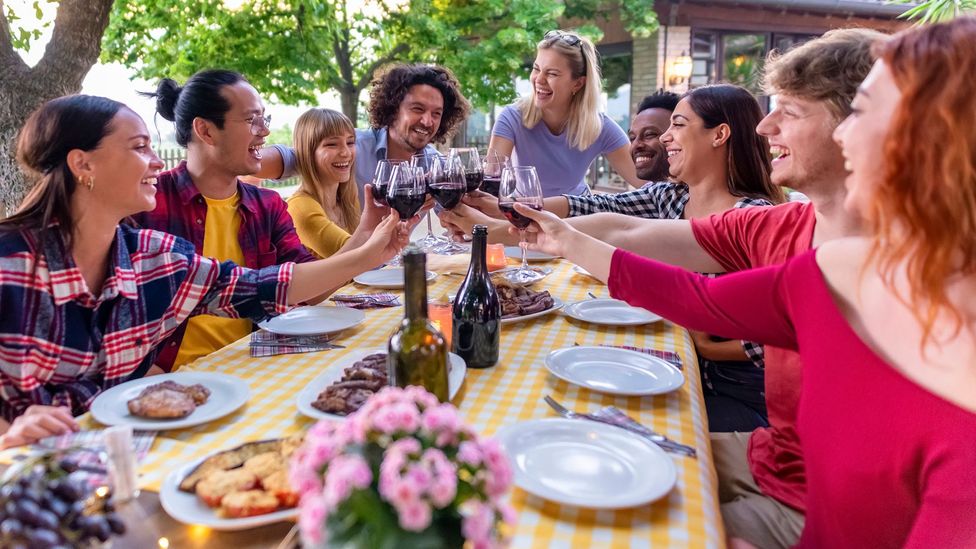
For some, things feel eerily normal – going out to the pub, seeing family and friends. But others may never feel settled once again.
D
Despite how tenuous the country of the world remains, in some means, life is starting to snap back into pre-pandemic normalcy in countries with high vaccine rates, similar the Usa and UK.
Major sport events are reopening to capacity crowds, indoor restaurants are bustling, people are going on maskless dates and air travel has nearly rebounded to pre-pandemic levels. The best part? It'southward all with the approval of national health agencies (for vaccinated people, at to the lowest degree).
And yet, for many, the idea of getting on a packed aeroplane to wing and visit elderly relatives for a vacation filled with hugs seems horrifying. It'south and then far from what nosotros've grown accustomed to over the last year and a half. Even if y'all're vaccinated, information technology might feel most incommunicable to revert dorsum to 'normal', as though naught always happened.
Why is it, among a mostly re-opened globe, that some of us withal feel scared and hesitant to cover the 'normal' lifestyle we all craved as nosotros were shut up in our own homes for more than a year? Experts say that for against feet in general, some people opt for a more gradual arroyo, and that the post-pandemic age volition be no different. And fifty-fifty though some permanent social effects of Covid-19 are unclear, many people will get to that feeling of 'normal' – eventually.
The scars are real
Fright and trepidation around returning to normal in the Covid-19 era is called 'post-pandemic anxiety' or 're-entry anxiety'. Health-care practitioners around the world have begun to accost and treat the result. Part of confronting that anxiety means confronting the reality of what happened over the final 16 months.
As of this writing, near iv one thousand thousand people across the world have died from Covid-19. For their loved ones, 'normal' might feel like it may never come. And many of those who haven't suffered traumatic losses are too reeling, struggling with 'long-haul' Covid symptoms that endure for months. Additionally, more than 100 one thousand thousand people have lost jobs during the pandemic, another trying factor.
So, information technology'south no surprise that many are finding the pandemic's effects are enduring. In the US, the Centers for Disease Control and Prevention institute in December 2020 that 42% of Americans suffered from low or anxiety – a huge increase from the 11% that was recorded prior to the pandemic. And many people are hesitant to terminate preventative behaviours. A study from final week showed that xl% of Britons want to go along wearing masks in shops and on send permanently, for example.
"Nosotros're never going to forget it. The human encephalon is kind of an additive organ – we add things to it, simply we don't decrease," says Kevin Larkin, professor of clinical psychology at Due west Virginia University, U.s.a.. "Nosotros're not going to forget that experience we went through, merely we tin control our behaviours going forrard,"despite the hardships we've collectively endured.
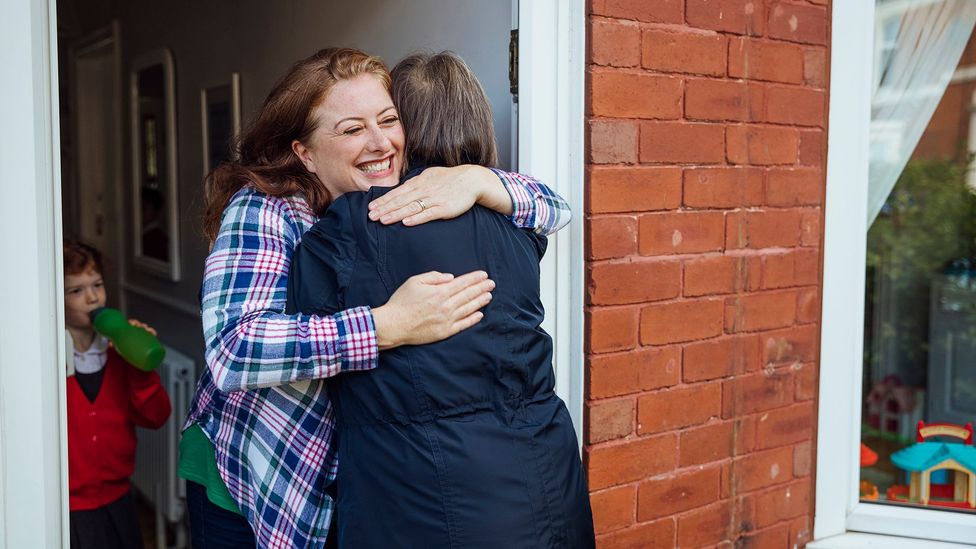
A woman hugging her mum, who was part of her pandemic 'bubble'. Some of us will exist more hesitant to leave that bubble in coming months than others (Credit: Getty)
Then, it tin take effort to find the will and comfort to resume the uncomplicated pleasures of reading a book in a café or embracing a friend – no affair how much you long for the hallmarks of life, circa 2019.
Dippers versus divers
Nonetheless, although it's seemingly simple to attend an outdoor sporting event when wellness officials say information technology's OK to do and then, some people seem to exist having an easier time entering the fray.
Larkin likens resuming a pre-pandemic lifestyle – or tackling annihilation that produces anxiety – to people who either dip their toe hesitantly into a cool pool, or people who hold their jiff and dive correct in. "Some people choose to ease into the water – and then other people prefer to get on a diving board and go far headfirst," he says.
In this way, re-entry into postal service-Covid-19 society isn't different from overcoming any other anxiety-inducing situation. "Social phobia, snake phobia, OCD – they're all different types of anxiety disorders that are characterised by developing habits to effort and minimise the feet," adds Larkin. "Usually, it'south avoidance."
That's why he says nigh of his patients take the 'dipping' arroyo. This process, called 'habituation' – getting used to something that addresses your anxiety – can be both emotionally and physically uncomfortable, which is why people practice it slowly, or don't do it at all. It's similar to cognitive-behaviour therapy (CBT), a common treatment for obsessive-compulsive disorder, which involves gradually exposing the patient anxiety triggers, to the betoken where they can live with them.
Of form, exposure isn't possible for high-take chances and unvaccinated people: "it's kind of like diving into the deep end of the pool and you lot don't know how to swim – there's actual danger at that place," says Larkin.
Merely for those who are vaccinated, risk tolerance is a cistron. "Some people might bounce back and go to the stadiums and the football game games and then on – only other people will be more cautious," says Steven Taylor, professor and clinical psychologist at the University of British Columbia, Canada, and author of The Psychology of Pandemics.
Plus, says Taylor, 'going back' to normal tin seem nebulous and unclear, particularly as different countries are withal at different stages of the pandemic, which tin make even vaccinated people even more than cautious.
"Pandemics are messy in how they end, and the ending is sort of arbitrary," says Taylor. "The WHO will announce ane day that nosotros're entering a post-pandemic flow, but what does that mean? The coronavirus is all the same around, infecting and killing people, but the rates are depression enough that it's OK to open up the economy."
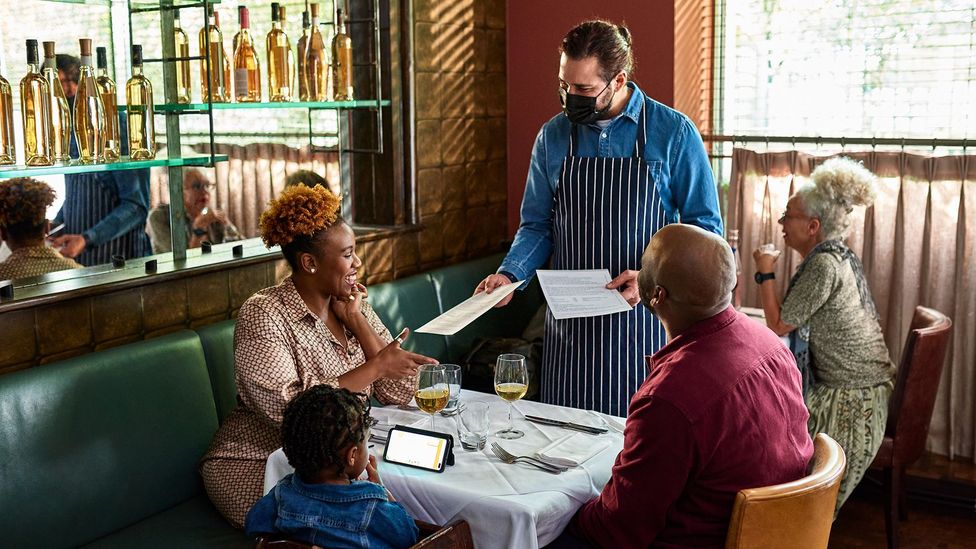
Experts saying doing activities like dining indoors can accept a while for people to become used to doing again (Credit: Getty)
Generalised feet, and the future
Anxiety aside, people are venturing back out – both dippers and defined.
A 29 June poll from marketplace-enquiry firm Ipsos showed that two-thirds of Americans hung out with friends and family, or went out to eat at a eating place, while only one-tertiary of Americans did some course of social distancing during the same week. Does that hateful the general sense of fear and unease that'south permeated society since Covid-19'due south outbreak will eventually disappear for skilful?
Taylor says that at that place will be some people who "will never render to normal" – including those lost a loved 1, or even lost a job, marriage or dwelling house. Even so, Taylor believes that this group volition be the minority; he says nearly people won't have any problem "eventually" reverting to normal. He says that was peculiarly the case with the 1918 Castilian flu – that it "was substantially forgotten", at least at a governmental or institutional level.
While countless individuals were traumatised, "there was very petty societal impact of the Spanish influenza. It'south really hard to find the psychological remainder over the past century due to the Spanish influenza," says Taylor. Even with more recent pandemics like H1N1, precautions like face masks "were rapidly abased" in Western countries.
For now, if you're feeling apprehensive with re-entry feet, "intermission it down into steps with something that feels easier and practice it, even though information technology feels scary", says Shari Steinman, assistant professor of psychology, and Larkin's colleague at Due west Virginia University. "Don't go to a crowded ball game on twenty-four hours one – start with playing catch with a friend."
It's yet too early on to pinpoint Covid-19's club-wide psychological furnishings. For at present, the process is individualised.
"Everybody is on their ain journeying, getting to the aforementioned place," says Larkin. "I think that people are going to take it at their own pace – and in that location's not a right or wrong stride."
Source: https://www.bbc.com/worklife/article/20210707-is-going-back-to-normal-even-possible

Post a Comment for "Real Lives: Could It Happen Again? Article"