Can You Get Bed Bugs From Hugging Someone
The Brown Peril
How contagious are bedbugs, really?
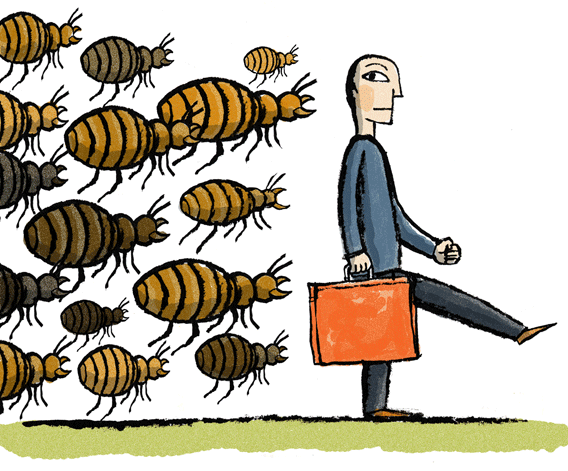
Analogy by Robert Neubecker.
In the months later the Civil War, the New York Times sent several writers to the South. Between covering horse theft in Richmond and pondering whether one could tell a "yank" from a "reb" based on physiognomy, the reporters grumbled about an odious feature of their hotels: bedbugs. I wrote that he had come "from frequent feel" to view bedbugs as a Southern institution no less entrenched than slavery. Another begged readers for the proper name of a decent Northward Carolina inn, complaining that the "natives" there immune bedbugs "total sway" such that "they now rule the Country during the hours usually devoted to slumber without opposition." He said he had tried to adopt the local custom of thinking "them'south merely chinch-bugs" just failed. "[A]nd now at 8 o'clock in the morning of the 13th day of March, 1866, I am seated at my table, having been driven out of bed four times already … writing to soothe my rage and drown the irreverence which wells up from my heart on business relationship of 'them chinch-bugs.'"
Not to dubiousness the yank reporters, but it is not clear chinch atmospheric condition were really less blasphemous to the North; one 1865 article said information technology was common to meet bedbugs "itch about the wearable of lawyers" in D.C. courtrooms. In that era, housewives swapped extermination tips alongside pudding recipes in newspaper household columns. Anybody had bugs, and it was very embarrassing. In 1908, a medico with the New York City Department of Health had the temerity to declare in the Times that bedbugs had sacked Gotham. He assured readers that "a curt zoological excursion" through any apartment or hotel suite would yield prove of the "brown peril." He exhorted New Yorkers to admit they had bedbugs, and stop insisting that the insects on the guestroom sheets "of course had been brought in from outside."
Blame the guests, blame the rebs, blame any other unfamiliar person or place. Amid the current outbreak, this fright of catching bedbugs from strangers has reached new heights. In August, Fauna Planet ran a show called "Bedbug Apocalypse" that warned, "There's actually nowhere to hide" and interviewed a adult female then addled by biting houseguests that she insisted on steam-cleaning her chairs before she would sit. One talking head said that if we don't act fast, "pretty much you tin be guaranteed that you are going to accept bedbugs home with you." It's a contagious fright: According to common belief, bedbugs are "globe-class hitchhikers"—they spread so readily that sufferers go treated like outcasts. Only is it truthful? Is a instance of bedbugs really that easy to take hold of?
Investigating the question entails a consideration of bedbug epidemiology. Public health experts ofttimes consider three key factors when estimating whether a plague will spread or die out: the rate at which people come up into contact with the pathogen, the duration over which an infection remains contagious, and the inherent transmissibility of the problems. Multiply these three factors together, and you lot get a value, called R0 (the basic reproduction number), that tells y'all the average number of people who will exist infected past any one case. If R0 is less than i, the contagion peters out. If it is greater than 1, the infection tin can spread.
We already know that R0 for bedbugs is in a higher place 1, since the plague has been spreading. In the current epidemic, hotel infestations accept been fundamental sentinel cases. Budget inns in West London became early on prey for Cimex lectularius in 1997. Four years subsequently, in 2001, outbreaks in big-city U.Southward. hotels popular amongst international travelers hinted that the resurgence was global—and acquired some to conclude the bugs came from abroad. Looking back at the equation above, hotels have a high "contact charge per unit"—they welcome a lot of strangers into bed—then rooms there are at elevated risk of infection. Some of these early on outbreaks tended to linger, boosting R0 , because exterminators at that point had little bedbug feel and infestations were not always completely eliminated.
Only what about the last gene—the natural infectiousness of the pathogen? If you stayed in a hotel that had bedbugs—if you lot curled upwardly in i of its bug-infested beds—what would be your chances of bringing them abode with you lot? That is to say, are bedbugs highly "contagious," like chicken pox? Or are they harder to laissez passer forth, like poison ivy? If we knew exactly how transmissible bedbugs are, we'd have a better sense of whether the Bedbug Apocalypse is really nigh. More chiefly, nosotros'd know how wary to be of motel beds, moving picture theater seats, and hugs from issues-afflicted buddies.
Scientists accept examined the medical consequences of bedbug bites and investigated their potential to spread disease. (There is no evidence they do, though bedbugs have been defendant, over the years, of spreading everything from cholera to polio to bubonic plague.) Few have studied their infectiousness, however. Many of the bedbug stats we hear originate from data gathered before World War II—complete with tales of zombie bedbugs surviving for three or four years without food—or ominous press releases from the pest-control industry (dutifully transcribed by leading newspapers) warning of bedbugs on trains, bedbugs in taxis, bedbugs everywhere! The average media consumer might be excused for thinking bedbugs are equally unstoppable as the contagions spawned in Hollywood's grey matter. Fortunately, information technology'south not truthful.
Clive Boase, a British pest consultant who works with i of the U.K.'south largest hotel chains, says managers of busy properties often assume at that place'south no way they can avoid communicable bedbugs. They may notation with a flash that some of their guests come from other European countries or otherwise take questionable hygiene. If you motion enough grubby strangers through a bedroom, they say, then one of them will surely infect it. So Boase ran a test: He selected several hotels with bad bedbug problems, assiduously eradicated the pests with insecticides, and then monitored the premises for 12 months to see how long it took for the bugs to be reintroduced. The plague never came back, non even after one property had served near 100,000 new customers. "I'k not disputing the fact that bedbugs are spread by people. … Merely I believe that the reinfestation rate is much lower than the pest-control industry would frequently have u.s.a. believe," he says.
Another information point comes from New York City's Department of Education, which maintains a kind of bedbug surveillance over its schools: teachers and staff are required to report issues sightings to the city, even if they've seen only one lonely insect. During the 2010-11 year, there were 3,590 confirmed reports of bedbugs in the school system's 1,200 buildings, which are used by a little over a million students daily. How many of these cases resulted in the establishment of a full-diddled colony on school grounds? Simply one time did an infestation flower—vii bedbugs were discovered making whoopee in the closet of a Queens high school last December. Gotham's vaunted serum-suckers thus gained a foothold in only 0.03 pct of their known school forays. Even this low figure may exist an overestimate. No doubtfulness other trespassers went undetected, catastrophe their days in a tranquility corner crack, gasping for a sup of claret. (Although bedbug lore says they tin can become for years without feeding, in reality they may last only a calendar month or two.)
The notion that it may be harder for bedbugs to campfire in dwellings than we have often imagined is supported by preliminary research into bedbug population genetics presented at a recent pest briefing in Brazil. North Carolina State University entomologist Ed Vargo has gathered bedbug specimens from dozens of sites up and downward the East Coast and analyzed their DNA to trace the outbreak's origins and spread. In the infested flat buildings he studied, he establish that all resident bedbugs were close kin, even across widely divergent floors. That suggests they all arose from a single pregnant female or a handful of her eggs post-obit a i-time hitchhike onto the premises. If successful bedbug invasions were common, Vargo says, he should see more genetic diversity. "Information technology's not like these things are beingness introduced constantly … it seems like these introduction events are probably kind of rare," says Vargo.
Naturally, a building's part affects its risk. Schools are not platonic hotspots; bugs prefer their foodstuffs to be sleeping (the better to reduce bloodsucking take a chance). Cinemas practice not seem to be havens: Richard Pollack of the Harvard Schoolhouse of Public Health says none of the specimens he has examined from moving picture theaters has turned out to be bedbugs. Bedbugs do best in dense, multi-unit housing complexes, where hiding places abound and infestations can linger like tuberculosis. This highlights a key epidemiological insight: Despite the mutual refrain that bedbugs do not discriminate betwixt princes and paupers, the poor are most at gamble. In New York Urban center, adults in the poorest neighborhoods are more than three times as probable to report having bedbugs as those in improve-off areas. The poor are at adventure because they often can't afford exterminators and may have unresponsive landlords—factors that increase the elapsing of infection. They also ofttimes rely on donated or 2nd-hand furniture, increasing their chances of catching bugs in the showtime place. Bedbug infestations thus are not random; they are reliably produced past social and economic conditions. Virginia Tech pest specialist Dini Miller says she separates the earth into two types of people: those who may get bedbugs merely will get rid of them, and those who may become bedbugs and will accept to learn to live with them.
Example in indicate: a low-income housing complex with 1,200 units in Richmond, Va. In December 2009, Miller learned from the former landlord that the complex was 90 percent infested. (The new owners won't talk over bedbugs with her.) From an epidemiological standpoint, these neglected edifices serve as reservoirs of disease. In out-of-control infestations, bedbugs can literally crawl out the door of ane apartment and into another. A sofa exiting this complex might harbor thousands of eggs. And every bit we have learned in other epidemics, the likelihood of transmission depends non just on contact betwixt infected and susceptible individuals, merely on viral load.
Since dose is key, the real threat is the motility of stuff , non people. The take chances of communicable bedbugs via person-to-person contact is minimal. Unlike bacterial contagions, there'due south no need to worry almost shaking easily with people with bugs. Simply how about hugging? The gamble of catching bugs via reckless hugging is extremely low, experts insist. Many draw the line at leaving your glaze on beds at parties, notwithstanding. Yet Miller, for i, says she doesn't bother with mutual precautions such as keeping 1's suitcase far from the bed in hotels. She regularly tramps through bedbuggy buildings and currently has 31 bags of bugs in her living room (she is testing fumigants), only has never defenseless an infestation. "Bedbugs are not the worst thing that'due south always happened to anybody. The people who freak out are the ones who have, similar, eight bedbugs," she says.
The prevalence of bedbugs has clearly gone up in recent years, but the rate of freak-outs has been increasing even faster. It'south essential to recognize that the "disease" is just not that easy to catch. Although the insects have fabricated a comeback— R0 is up—they are hardly lurking in every double-decker stop and banquette, as folks in the bug-busting concern might have us believe. (Richard Pollack points out that ninety percent of the "bedbugs" he is asked to examine plough out to be other kinds of insects—or fifty-fifty specks of lint.) If the brown peril does strike, victims should remain at-home and enlist professional help. Recently the CDC reported on a rash of poisonings in which people got sick later on nuking their infested homes with insecticide, and history shows these episodes of friendly fire to exist the bug's deadliest effect. In the 19th century, reports of accidental death from drinking bedbug poison, suicide by insecticide, and fatal fires during issues exterminations—such equally the tragic case of a New Jersey jeweler'south married woman who accidentally roasted her spouse and infant child while fighting bedbugs with benzene in 1893—were all too common.
This is not to suggest we are regressing, entomologically speaking, to the buggy Victorian era. In fact, there is some evidence that the current bug craze could exist topping out: Co-ordinate to new data from New York City, landlord bedbug violations declined in 2022 for the first fourth dimension since 2004. Experts view New York's bedbug problem equally relatively mature, since the city is often seen as the epicenter of the outbreak. If New York'southward drib is existent and sustained, it could stand for the beginning of a broader decline in bedbug prevalence, a downgrading of their international hobgoblin status, and a welcome reduction in nocturnal irreverence. The little devils are not worthy of our rage. Subsequently all, them'southward simply chinch-bugs .
Dave Johns is a doctoral student in Sociomedical Sciences at Columbia University'due south Mailman School of Public Health. Amy L. Fairchild is a historian and professor of Sociomedical Sciences at Columbia University'south Mailman School of Public Health.
Source: https://slate.com/technology/2011/10/bedbugs-how-contagious-are-they-really.html#:~:text=The%20chance%20of%20catching%20bedbugs,hands%20with%20people%20with%20bugs.&text=The%20risk%20of%20catching%20bugs,is%20extremely%20low%2C%20experts%20insist.

Post a Comment for "Can You Get Bed Bugs From Hugging Someone"